Grace Baptist Church
Children of the CornGrace Baptist Church is the former name of Gatlin’s church, a building Burt enters while trying to understand the town’s eerie quiet. Its changed name and corn-based religious imagery reveal that the familiar Christian institution has been remade to serve Gatlin’s worship of He Who Walks Behind the Rows. As Burt discovers, the transformation is not merely decorative: the church’s altered texts and records belong to the same belief system that organizes the town and its sacrifices.
Setting and Name
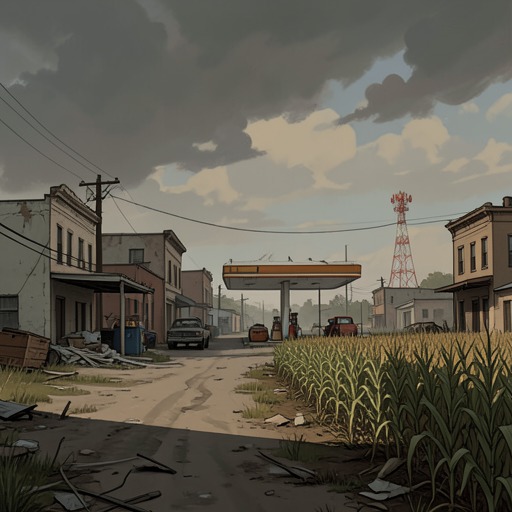
Burt and Vicky approach the church after finding Gatlin largely deserted. The town’s public signs and facilities seem suspended in an earlier time: a sign gives the population as 5,431, while a gas station lists regular fuel at 35.9 cents and high-test at 38.9. Vicky points out that those prices are years out of date, and that there are no cars in town. The church stands out from this neglected setting. Its grass is cut, flowers are tended beside the flagstone path, and the building looks cared for when other places appear dusty and unoccupied.
The church’s sermon board carries the message “THE POWER AND GRACE OF HE WHO WALKS BEHIND THE ROWS,” dated July 24, 1976, the previous Sunday. Burt recognizes the name as a local name for God, but the board unsettles the ordinary Christian appearance of the building. Vicky refuses to go inside with him. Burt enters alone, initially expecting only a brief look around.
Inside the vestibule, a jumble of eighteen large wooden letters gives him a material clue to the church’s history. He rearranges them and works out that they once spelled Grace Baptist Church. The letters have been taken down and left among the dust, while the vestibule around them is tidy; the exterior has been painted so that the old lettering is no longer visible. The church has not simply acquired a new sermon or sign. Its former public identity has been physically removed, though the discarded letters preserve evidence of what it used to be.
A Church Recast
The sanctuary makes the change unmistakable. Behind the pulpit is a large, crudely painted image of Christ with a broad, unsettling grin and corn growing as green hair. The eyes contain figures apparently drowning in fire. Burt sees the image as a pagan or Old Testament version of Christ, a figure who might sacrifice rather than shepherd. The mural fuses Christian iconography with the local corn faith, making the church’s new allegiance visible at the very center of its worship space.
Other alterations turn the building’s fixtures into statements of belief. The pipe organ has had its keys torn up and stops pulled out; dry cornhusks fill its pipes. A plaque above it declares that music should be made only with the human tongue. The ruined instrument is not just neglected: its disuse is explained through a rule presented as divine command. The church therefore regulates not only what its congregation worships but how worship may be performed.
Burt also finds that the Bible has been cut, mostly in the New Testament, while the Old Testament remains intact. Nearby, a book bears the inscription “THUS LET THE INIQUITOUS BE CUT DOWN SO THAT THE GROUND MAY BE FERTILE AGAIN SAITH THE LORD GOD OF HOSTS.” Its childishly formed letters introduce a local record of births and names. The inscription links the town’s religious language of removing the “iniquitous” to the fertility of the land, while the altered Bible shows that the community’s doctrine selectively edits inherited scripture rather than abandoning its authority.
Records and the Town’s Order
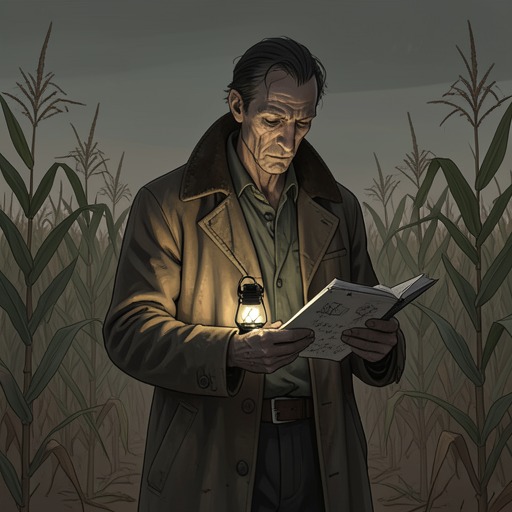
The birth records are written in columns, with large, drawn-looking letters and evidence of careful erasures. Burt finds the last entry in one volume for Ruth Clawson, born April 30, 1961, and then discovers two more books carrying the same religious inscription and continuing the list. In the next volume, an entry from early September 1964 records Job Gilman, born September 6; the following entry is Eve Tobin, born June 16, 1965, without a second name in parentheses. The records make the church an archive as well as a place of worship. Their sequential names and dates register the children who make up the community, while the erasures and the child’s hand leave the process of record-keeping visible and imperfect.
The congregation’s doctrine is also broadcast beyond the building. As Burt and Vicky approach Gatlin, a nearby radio preacher speaks of atonement, condemns worldly life, and names defilement of the corn among the sins that leave no place in heaven. The broadcast helps establish that the church’s corn-centered religion is part of a wider local system of teaching, not an isolated image or private eccentricity. In the town itself, the neat church and its sermon board offer the clearest public statement of that system.
The church’s religious practice is connected to the rule called the Age of Favor: after Isaac announces that the required age has been lowered from nineteen plantings and harvestings to eighteen, Malachi and Joseph are identified as the eighteen-year-olds present. Malachi accepts the command, and those now above the Age of Favor walk into the corn that night. The narrative thus connects the town’s religious authority to a specific age rule and to sacrifice in the fields, beyond the church walls.
Threat and Significance
The church also becomes the setting from which Burt sees the danger closing around Vicky. While he is inside, the T-Bird’s horn begins to blare. He runs out and finds Vicky upright behind the steering wheel as children approach from around town and the school playground. They carry knives, hatchets, pipes, rocks, hammers, and a jackhandle. The church’s place in the scene is significant: Burt has just encountered the beliefs and records that expose Gatlin’s changed order, and he emerges from that evidence into the physical threat posed by the children who enforce it.
The contrast between the church’s maintained grounds and the town’s empty streets sharpens its role. Gatlin appears quiet and nearly abandoned, but the church preserves an active authority through its new name, doctrinal message, altered furnishings, scripture, and records. Its discarded letters make the earlier institution legible only as a trace; the corn mural and husk-stuffed organ show what has replaced it. Grace Baptist Church is therefore both a specific building Burt investigates and a concentrated map of Gatlin’s transformation, where familiar religious forms have been redirected toward the corn and the community’s sacrificial order.